Tell us about yourself: I am the proud owner of a dutch shepherd pup named Chief! I am also the proud owner of a jack Russell/ chihuahua mix named Starsky. I completed school to be a vet tech and I now travel with my husband.
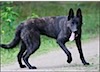
Hello, as you might know I have a 13 week old DS named Chief. I know he is still a puppy but we have a couple problems we need help with before they get out of hand.
Our first problem is that he hates his crate. He does fine at night and only barks a few times then goes to sleep for the full night. The problem is getting him to go in the crate. At night he calms down rather quickly, but during the day he is frantic. He barks non stop and paws at the door for a little bit. I have tried socializing him properly with treats and he has no interest in food once the door is closed. The vet recommended using a Kong with food stuffed in it but still no luck. We have crate games DVD but we cant get to the point to even start the training offered on the DVD.
The second issue is that while walking, he is constantly pulling on the leash. I really don't want to use a pinch collar if I do not have to, especially at this age. I want to correct this while he is young so we do not have a bigger issue later on. Any ideas or suggestions would be appreciated.
Attachments
2014-06-25 20.39.06.jpg (135.05 KiB) Viewed 3978 times
Tell us about yourself: First Dutch owned. Was bought for my daughter and the family. Currently going through obedience classes. I am former military and currently working for a law enforcement agency. Have had labs most of my life and a friend introduced me to his Dutch and my family fell in love. Our current one is a female named pepper and is just now 3 months old. I would like to possibly train her for search and rescue
There are some other members here that can offer better advice for the crate training then I but as for the leash repetition, repetition, repetition. As soon as chief starts to pull a head gently pull him back to your side (left or right) and give the heel command (shoulders should be at the side of your leg for heel). As he begins to understand that his natural walking position is at your side it's good to work in stopping and having him return to you without the command having it be his idea. And don't start walking again until he is at your side. Of course this is down the road but it helps to have him know that's where you want him and where he wants to be. If this sounds wrong help me out fellow members.
I know you said you didn't want to resort to a pinch collar but they are a very good tool to use. Every time we are out and around pepper has hers on. I have never had to pull hard or jerk aggressively with it. Just continuous slight pressure and a firm command has worked very well for me. But make no mistake it took months to get where we are at now and continual training still.
Tell us about yourself: I am a mom of 6 life forces - 2 kids and 3 dogs 1 hamster. I live in Ct. I have trained Ringsport and Agility and have 2 DS, one 15 and 7 and a Basset Hound Cookie who is 2
For the day, are you going out when you put him in? If so, then make sure you put him in while you are home. When Sadie was a pup, she would go into her crate daily and it was always a positive experience. I would always make sure there was something of mine in there and a toy.
If it is just to put him in, and as soon as you do and you are not going out, I am at a loss.
Feed him in the crate and do everything positive in there. Keep putting a treat in there and let him find it by himself, throw a toy in there while playing so he has to go in and get it, Put your things in there so he has your smell, just think of anything playfull so he goes in. Thats all I can think of. IM sure there will be better advice for that.
Im going to agree with Casey, the pinch collars are not a medieval torture tool if you use it properly. As Sadie got bigger she would yank the crap out of my arm, I got a small dog pinch with extra prongs and I never had to do anything, we would do some training with it and she got it right away and that was it. A bit of pressure and they get the idea. Now I always have one on her and I never have to do anything, she knows what it means and it saves my elbows from being torn up.
Tell us about yourself: My name is Karen and I have a dutch shepherd, Xander, born 6/14/13. He is my second dutch shepherd. My first was Rawly. Even though Xander is my second I still have a lot to learn. That is why I'm here, to learn, get advice, and meet people who love these guys as much as I do.
With Xander I would put him in the crate. He would throw a fit and I would walk back in and tell him NO, QUIET. Eventually he would get quiet, might only be for 30 seconds, but as soon as he was quiet for a short period I would let him out and give him a treat. I would slowly increase the time he had to be quiet before he was let out. If he threw a fit before I let him out he was told NO QUIET again and we waited. Once he stayed quiet he was let out and given a treat. This took a couple weeks of doing this a couple times a day but he eventually would stay quiet for as long as he was in there. I don't know if this was the ideal way of teaching him but it worked great for me. It was frustrating at first because he would start throwing a fit before I let him out and we had to start over and wait. But after a couple days he figured it out.
To all: is he old enough for a prong without risking damage?
Until he learns the difference between a loose-leash walk and a walk-is-a-walk, I wouldn't keep slack in the line. Couple different things: the instant he starts to move ahead, go in other direction; as he catches up and is at your side, mark the behavior. Or, the instant he starts to move ahead, stop; don't move until he comes back at your side; mark; slowly start walking again. If you don't have slack, it's harder for him to gain footage. Mark when good. (Do you use a sound--like "Eh"--as an indicator to check his behavior--that what he is about to do he needs to think about?)
If you started introducing him to heeling at your side during regular OB sessions using marker training, it might be easier for him to connect the dots on walks that his place is beside you.
Though I can only hope to become the person who my animals believe I am, the things that they have taught me have made me a better human being. ~~~Sharon~~~
Crate - ignore, ignore, ignore. And practice. Put him in and ignore. Don't say anything...let him think about it. He needs to make the decision to accept his environment (wherever it is) on his own, not just because you tell him he has to. These are thinking dogs, let him think and work it out (invest in earplugs and headphones ). When he settles down and accepts the environment (truly accepts...meaning laying down relaxing or sleeping), then you let him out. He needs to learn that hissy fit does not equal getting out. Acceptance does. Be consistent. Then you increase the amount of time you leave him in there after acceptance. He'll get it, I promise. And I 110% agree with Lisa...1) he gets fed in his crate...EVERY TIME, and 2) toss random treats in there and let him find them. Make it a game...leave a trail for him to use his sniffer...you'll accomplish 2 things at once.
Leash pulling - Don't over-think it. Sharon, we are on the same page as far as walking goes.I would leave words out of it for now and just focus on shaping the behavior you want. Once you shape, then you name, otherwise it's just a random word that means nothing. When he starts pulling, you turn around and go the other direction. Don't say anything and don't use any pointed leash correction (your turning around mid-step is an auto correction). This process can be cumbersome (and dizzying, lol) but it works by letting him know that he has to keep at least partly focused on you. You can mark and treat if you like. I didn't, but that is just personal preference. At this point I personally wouldn't use a pinch. I agree with Sharon on the age thing and you want to shape first. See how he reacts to the mid-step turn. And practice everywhere, even in the house and in your back yard. Repetition is key. And be consistent. He'll get it...faster than you think.
Side note on pinch collars: Be VERY careful. A pinch collar is an awesome training tool, but it can also ruin a dog. Never use a pinch correction unless the dog knows the word it is associated with *first,* e.g. "sit." Unless the dog knows what "sit" means, you DO NOT correct if you ask him to perform the behavior and he doesn't do it. You shape first, then you can add the pinch correction in. Think of it this way...it's like a spanking for a child. You don't spank your child for coloring on the walls if he doesn't know he's not supposed to. You teach first, then correct. Same principle with a pinch. If the dog doesn't know *why* he is getting corrected, it will cause fear and fear can lead to fear-aggression (with dogs and people).
~Stacy
Mom to:
Tyson - DS mix (Hendrix's Soul Sibling and Dinga Roo's long lost twin)
Baby Ruth - Miniature Schnauzer
Snickers - Miniature Pinscher http://www.rescuedme.org
Tell us about yourself: I am the proud owner of a dutch shepherd pup named Chief! I am also the proud owner of a jack Russell/ chihuahua mix named Starsky. I completed school to be a vet tech and I now travel with my husband.
We have been trying to put him in the crate during the day for a few minutes even if we are home, hoping that it will help. The instant he goes in the crate he has no interest in food. Should I just leave him in it until he calms down and eats? With walking we will give it a shot.
Devo7 wrote:We have been trying to put him in the crate during the day for a few minutes even if we are home, hoping that it will help. The instant he goes in the crate he has no interest in food. Should I just leave him in it until he calms down and eats?
There are a couple ways to approach it.
1) you can put him in with his food and just wait for him to calm down and eat, or
2) you can put him in without his food and then when he calms down you give him the food, or
3) you could feed every meal this way:
line of kibble from point A (wherever you choose) to and into the crate with the majority of his meal in the very back of the crate as a bonanza.
If he truly despises his crate and goes out of his mind, and if it were me, I would start with #3 and work up. I would want to help him to make the decision to go in there on his own.
And then intermittently throughout the day do some treats the same way with maybe the bonanza being a frozen kong.
~Stacy
Mom to:
Tyson - DS mix (Hendrix's Soul Sibling and Dinga Roo's long lost twin)
Baby Ruth - Miniature Schnauzer
Snickers - Miniature Pinscher http://www.rescuedme.org
Tell us about yourself: First Dutch owned. Was bought for my daughter and the family. Currently going through obedience classes. I am former military and currently working for a law enforcement agency. Have had labs most of my life and a friend introduced me to his Dutch and my family fell in love. Our current one is a female named pepper and is just now 3 months old. I would like to possibly train her for search and rescue
Stacy and Sharon you are right. I forgot to mention that I didn't start using the pinch with pepper until we were well into her obedience training and she understood her command words.
I don't know the age a prong can be started--with gentle use--on a puppy. Indeed, the prong is a tool and can ruin a dog if used improperly, but on a young pup it can damage them physically. (And over-use can dull the meaning of the correction over time with most any dog.)
(I can't use a prong on my guy; it amps his drive. I'm not against their use when used properly when there's continued reluctance--not doubt/uncertainty--with a particular avenue of training.)
On a note about teaching heeling during a walk: if he's staying beside you yet seems to veer away laterally (a lot of dogs don't do this to say "I'll show you!" but rather, they're having trouble getting the hang of it), you can walk them between you and a wall or a fence--sandwich-style. They kind of have to pay attention--the wall/fence acts as a guide.
Though I can only hope to become the person who my animals believe I am, the things that they have taught me have made me a better human being. ~~~Sharon~~~
Tell us about yourself: I am a mom of 6 life forces - 2 kids and 3 dogs 1 hamster. I live in Ct. I have trained Ringsport and Agility and have 2 DS, one 15 and 7 and a Basset Hound Cookie who is 2
One thing I wanted to say but forgot this morning.............when we taught the heel, we would use the tug and hold it up and let the dog see it. We had the tug in our right hand since we taught our dogs to heal on our left, so the tug was in our right hand, our arm was across our belly, like if you had it in a sling, so the tug would be hovering over their heads. What this did is help with the "look" command since we want them to look at us while in the heal, and it helped keep them in the heel since they wanted the tug so they stayed at our sides to try to get it. Many times they would bounce up and down to try to get it , but we just ignored it and then made frequent stops to give it to them as a reward.
I think prong could hypothetically be used between 6-8 months, but again, well into OB.
For the crate I always let Hendrix as a puppy eat in the crate with the door open, secret treats into it when he wasn't looking, throw the ball in when we were playing fetch, etc. Everything I could to show him the crate wasn't bad. Once he would rush into his crate to be fed (which took a few days of these games) I would start working on closing the door, at first just motioning like I would, then touching it, then moving it, then starting to close it an inch, then two inches, then three inches, and keep moving until the door would close. Depending on how he was, i.e. relaxed and not paying attention, I would do this several times or if he was looking stressed back off. Once he was cool with the door closing and locking, we started working on length. He'd run in to eat, I'd close and lock the door, and wait a second, two seconds, three seconds, etc and built on the length. Again, sometimes I'd do this several times and others just once. I'd vary them too. Basically the idea was that if the door closed it didn't mean it wouldn't ever open again, like when I was gone.
If I was gone, he had bones and an old shirt with my scent that I didn't mind if he ripped up. Sometimes I would take his Nylabone chew and rub it in-between by hands for a few minutes. I think he was around 5 months when he decided my scent was not needed and it would be more fun to rip up my shirts than cuddle with them. Also, if it looks to you like he's just super stressed in the crate, if you could keep him in a room or enclosure that isn't the crate while you're gone for two to three days, this may help him "reset" so as you're playing the games he's not going, "good crate when we play, bad crate when they leave". Not a big deal if you can't.
Once he was okay with the door closed I started playing Crate Games. My best advice is try a mixture of everyone's advice and get creative - my guy's biggest problem was he didn't like the wire crate but missed the comfort of his Kuranda bed, so I zip tied peg board to sides of his wire crate like Stacy had suggested for me to make a pseudo-enclosure (because he pulled blankets through) and he hasn't had a problem since. Just cries if it's time to go out.
Also for leash walking… the only thing that worked with my guy was keeping him on a short lead (with two feet of my body because for me that's an alright area for him to walk) and the second the leash started to get tight, stop. And I mean dead stop, not "let me finish my step" stop. When he came back to me I'd treat and start walking. It took a while but he started to understand where he needed to be. As he got better I gave him a bit more lead (after giving him a release) and if that got tight I'd stop dead.
Another idea a trainer gave me was to walk with the leash in your dominant hand (for me the right), and take a hold of the leash with your left, so you're holding most of the leash against your torso, so Chief wouldn't have too much leash to work with. As he nears the end of the leash, whistle or cluck or make a noise to get his attention. The second he turns to you, you mark and give him a treat, which he has to come back for. As he progresses, you start withholding the treat for longer and longer so he has to walk besides you for longer lengths. So what that will look like after time is as the leash gets tight he'll return to you. If after he is treated and he doesn't go running off but stays by you, you also treat for that, again slowly reducing the frequency of treats. This encourages him to remain by your side. If he wanders off and won't leave a particular good smelling spot alone - you keep walking and say a command (come on, with me, let's go, whatever will mean keep moving) and eventually he'll be triggered by the leash pressure to return to your side or will be pulled away. It worked with Hendrix for a while until he decided treats were not more interesting then smelling, but the command for keep moving still works (and off leash too).
Kay, H, and The SO
(Pepper's Look-A-Like)
(Tyson's Soul Twin)
Tell us about yourself: I am the proud owner of a dutch shepherd pup named Chief! I am also the proud owner of a jack Russell/ chihuahua mix named Starsky. I completed school to be a vet tech and I now travel with my husband.
Owned-By-Hendrix wrote:so I zip tied peg board to sides of his wire crate like Stacy had suggested for me to make a pseudo-enclosure (because he pulled blankets through) and he hasn't had a problem since. Just cries if it's time to go out.
YAY!!! It worked for you!!! It was a winner for us, for sure.
~Stacy
Mom to:
Tyson - DS mix (Hendrix's Soul Sibling and Dinga Roo's long lost twin)
Baby Ruth - Miniature Schnauzer
Snickers - Miniature Pinscher http://www.rescuedme.org
Tell us about yourself: I am the proud owner of a dutch shepherd pup named Chief! I am also the proud owner of a jack Russell/ chihuahua mix named Starsky. I completed school to be a vet tech and I now travel with my husband.
We have progress! Since he has started eating his meals in his crate, he seems to have calmed down about it. There has even been a couple times he has not barked at all when we left.
Attachments
2014-07-02 08.45.01.jpg (378.78 KiB) Viewed 3888 times
Tell us about yourself: I am a mom of 6 life forces - 2 kids and 3 dogs 1 hamster. I live in Ct. I have trained Ringsport and Agility and have 2 DS, one 15 and 7 and a Basset Hound Cookie who is 2
Excellent !!!!!!!!!!!! I always fed Sadie in her crate and made sure there were tons of toys and stuff that smelled like me. I never put her in the crate as a punishment so the crate is a good place.


 Facebook page.


 ). When he settles down and accepts the environment (truly accepts...meaning laying down relaxing or sleeping), then you let him out. He needs to learn that hissy fit does not equal getting out. Acceptance does. Be consistent. Then you increase the amount of time you leave him in there after acceptance. He'll get it, I promise. And I 110% agree with Lisa...1) he gets fed in his crate...EVERY TIME, and 2) toss random treats in there and let him find them. Make it a game...leave a trail for him to use his sniffer...you'll accomplish 2 things at once.