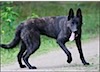
Tell us about yourself: We rescued a Dutch shepherd mix puppy from a local organization. The owner assured me this would be a great dog for us. We do stay home all day but I am learning now about the nuances of the breed and could use some experienced owners to discuss with.
My name is Carla and I the proud owner of a Dutch Shepherd mix. I have no idea what he is mixed with. We rescued him from a local rescue organization. The owner said we would be great for him and vice versa.
Wow I wonder how she came to that conclusion.
We named him Bear, and he is around 4.5 months old.
He's a pretty good boy. He lets me handle him almost anyway I want UNLESS he wants to do something I don't want him to. Then he gets pretty angry. It's manageable now, but I'm afraid of when he gets too big for me to handle. Plus, I have two little girls.
He learns quickly with positive reinforcement (treats!), but he doesn't respect any type of correction. He only gets more agitated. So, I'm trying to figure out what motivates him to STOP an uwanted behavior. If something distracts him then it seems to snap him out of it but I don't know how to do this on my own.
Any advice that's specific to the breed would be greatly appreciated. All the dog training sites out there are all rehashes of the same old "positive only".
Tell us about yourself: We rescued a Dutch shepherd mix puppy from a local organization. The owner assured me this would be a great dog for us. We do stay home all day but I am learning now about the nuances of the breed and could use some experienced owners to discuss with.
I have had several dogs throughout my life. As a child we had a mutt, a toy poodle and a Pomeranian. As an adult I had a chow who was an awesome friend (whom I had to re home when I moved) another toy poodle who was my baby and I loved dearly (I had to re home her when I had my second child and she had a lot of health issues as a baby).
I trained both the dogs I had as adults and both were great companions. I could handle both of them easily as well. But out of all the dogs lives I've ever been a part of, all of them realized quickly with a "no" and redirection what I didn't want them to do.
I'm hoping it's just going to take more time with Bear.
The girls are 8 and 10.
I have had him almost 3 weeks.
We stay home and home school so we literally spend almost all day with him when he's awake. We "work" a lot. We work on commands and manners and leash walking. I give him "puzzles". We run around the yard. We play hide and seek. We play frisbee and fetch. We go on 2 mile walks on some days.
So I know for sure he's not bored. Maybe he's too tired?! I know I am.
The kids are both educated on how to respect dogs and not harass him.
Mostly he's a good dog. He allowed me to trim and file his claws today.
His attitude comes out when he wants something and he can't have it.
I probably worry more now with a big dog because I don't want to create a situation where he hurts a child (or me!) because that's not fair to him or us.
Thanks for letting me hash it all out here. I really wanted a good companion dog, and I hope he will be but boy, it seems like it might take forever to get there.
Tell us about yourself: We rescued a Dutch shepherd mix puppy from a local organization. The owner assured me this would be a great dog for us. We do stay home all day but I am learning now about the nuances of the breed and could use some experienced owners to discuss with.
Dutch shepherds really aren't meant to be companion dogs and nothing else. So you don't have working dog experience?
if your dog is indeed a DSD mix and has the corresponding traits, you're in for a highly driven dog who will herd your kids when they act like prey (running, squealing), and will need a job and a firm and confident hand. A bored DS is a destructive DS, and it sounds like you're keeping him active, but I would really recommend working with a professional trainer with working dog experience, and experience with DSD or Malinois
would be even better.
Glad your girls are a bit older; for some reason I was thinking like 5 or younger. For pictures, if you can't get them to attach using the uploader, you can host them at imgur or photobucket or any other photo hosting site and just paste the BB code in your post.
Oh, and welcome to the forum! I'm sure some more experienced DS owners will chime in.
Tell us about yourself: We rescued a Dutch shepherd mix puppy from a local organization. The owner assured me this would be a great dog for us. We do stay home all day but I am learning now about the nuances of the breed and could use some experienced owners to discuss with.
So, there's really no hope in him mellowing out in a few years?
What do professional trainers offer that I can't do? Luckily I'm a pretty stern person. I just need to know what works and what doesn't. I've figured a few things out, but I guess I'm just concerned that no matter how much I do for him, he's still not going to be interested in doing anything BUT work.
He's a cutie! The most I could possibly guess is a DS/GSD mix as his face looks a weeeee too wide to be total DS, but pics have been known to lie (no one's fault), so he may be full DS. Did the owner know for certain he was a DS mix?
DS need to work. They're nothing like GSDs, or chows, or labs, or poodles, and they give the border collies and aussies a very good run for their money. They don't lay around, they don't chill, and if you ever catch one sleeping they'll awake and be ready for the next thing once they sense your very twitch. They can be calm in a house (which is taught and after meeting certain needs) but they aren't lazy or happy with less than a very active (physically and mentally) home. They need to have a job, need to be mentally active, and have fair, respectful, and courteous leadership. My guy has several jobs, which we perform daily, we also train OB, tracking, and protection work daily for a few hours, and walk 3+ miles a day. If I skip some of the stuff or don't have time, now at almost 2 years he'll wait and behave until.... until basically he can't stand it anymore (which is a day). They're basically dogs that have 6-12 genius flying sugar high toddlers inside of them. These are also dogs that bond to one handler and will only respect one handler. They can live in families and get along great with everyone, but there will always be that one person they follow around like a shadow, listen way better to, and generally prefer.
They're also super protective. You'll probably be seeing more and more of his protection streak coming out as he gets older, as a full DS or a DS mix.
As far as training... they're smart. Like figure you out in no time smart. For the acting out, I'm assuming he's getting mouthy, snarl-y, or "talking" back at you...? He's basically throwing a temper tantrum and oh boy get ready when they hit 8+ months. I would say, as a general person on the internet not knowing the details and nuances of your relationship with him, that 1) is testing the limits of what he can and can't do (if I show her my teeth she backs off and I get my way), 2) he may be tired and grumpy and needs nap time, 3) needs a lot more time with OB, and/or 4) needs way more time bonding with you in a way he needs (I know we as humans say "I spend all day with him!" but that generally isn't how a DS wants to bond). There's not a tried and true method for working with the DS, not because none work, but because each DS responds so vastly different to each methodology. My one friend had a puppy that at 6 months he had to put a prong collar on to correct, while another's responded to a "no", another's practically peed at the handler's cross eye, and mine needed to be corrected how a momma dog would. These are the dogs that need bits and pieces from different methods but you'll find the key theme of positive reinforcement, respect between you and the dog, and crystal clear communication that works however it will between you and the dog.
As far a mellowing out... I think as they get older, you have to understand what mellowing out means to you and what it means to them. My guy has a certain level of exercise, training, and work he must get every day to be happy and nondestructive/bad. It is far less than what he needed as a puppy. Will he ever lay around the house and not need to be worked 3-5+ hours a day? Nope. Will he get easier to manage as I learn what he needs and he learns what I can give him that's within the range of what he needs? Yes.
There are plenty on the forum who don't "work" their dogs in traditional dog sports - agility, flyball, protection sports - but work with them in another way such as obedience, tracking, and other creative ways. But they do work them. The reason why some of us will recommend trainers experienced with working dogs is because these dogs are not "pets" the way most trainers see "pets". My guy alone traumatized about 50 different "household pet" trainers because they simply did not understand his needs, the way he worked/thinked, and tried to just place him into a mold. One example was a trainer who tried to force him to go up and greet everyone with a certain ritual. My guy did not want to meet people. He did not want them meeting him. But by that trainer's standard, as a pet he should want to meet everyone. Another trainer practically freaked out because he growled at her for trying to take his bone. He was labeled "resource guarding" and "scary". The truth? He's possessive, which is different from resource guarding and much looked for in protection sports, and didn't need to be squashed or diminished. A little bit of work, some BS calls, and I can take things away from him because he knows if I do it's for a serious reason. What I'm getting at is that there are certain things pet trainers may not recognize as certain inherited characteristics of true working dogs, such as aggression, possession, defense, nerve, and strong attitude. It's totally possible to have a working breed that isn't the super aggressive unfriendly stereotypical "working dog" image most have, but it requires understanding that there are certain things you'll never change so you accept it, make a compromise, and move on. My compromises are very few considering he's a working dog, but many in the eyes of people who have never owned one.
If you're dedicated to Bear, give him jobs, pour thousands of hours into his training, and deal with the BS he tries, you'll have the best dog ever. Seriously. I wouldn't trade my guy for the world, despite the bills he racked up as a puppy, the hours of work and training and exercise I put into him every day, and all his craziness. He's my diamond and now, almost 2 years later, I'm reaping back every ounce of sweat, blood, tears, and effort I put into him 10 fold. I call him a companion but in truth he's a highly active working dog. But I think you need to figure out what you want in your dog (as future 2+ year old dog) and see if Bear will/can meet those wishes.
If you have any Qs feel free to ask and browse the forum threads. You'll see all sorts of crazy fun stories, training experiences, and advice. As far as your problem with Bear, I would suggest starting a new post in Behavior so everyone can chime in. Adding a lot of info about what his exact reactions are to what you do when he doesn't get his way is helpful - the more info we have the better we can hopefully advise. We aren't here to tell you you're a horrible owner, put you down, or that you shouldn't own the breed, or anything like that. All we want is for you and Bear to be happy and fulfilled.
Kay, H, and The SO
(Pepper's Look-A-Like)
(Tyson's Soul Twin)


 Facebook page.
 I wonder how she came to that conclusion.